

Political Pūjā
The need for a hero or at least a villain


The desire to care is core to all of us. If we look honestly at our lives, we may notice something curious: we are almost always rooting for someone. We cheer for heroes, defend our side, and feel strangely energized when confronting villains.
I briefly spoke about this in my article, What is Love? But here I would like to dig deeper into a related instinct: the human—or rather the soul’s—need to honor, defend, or fight for someone or something.
Hero Worship
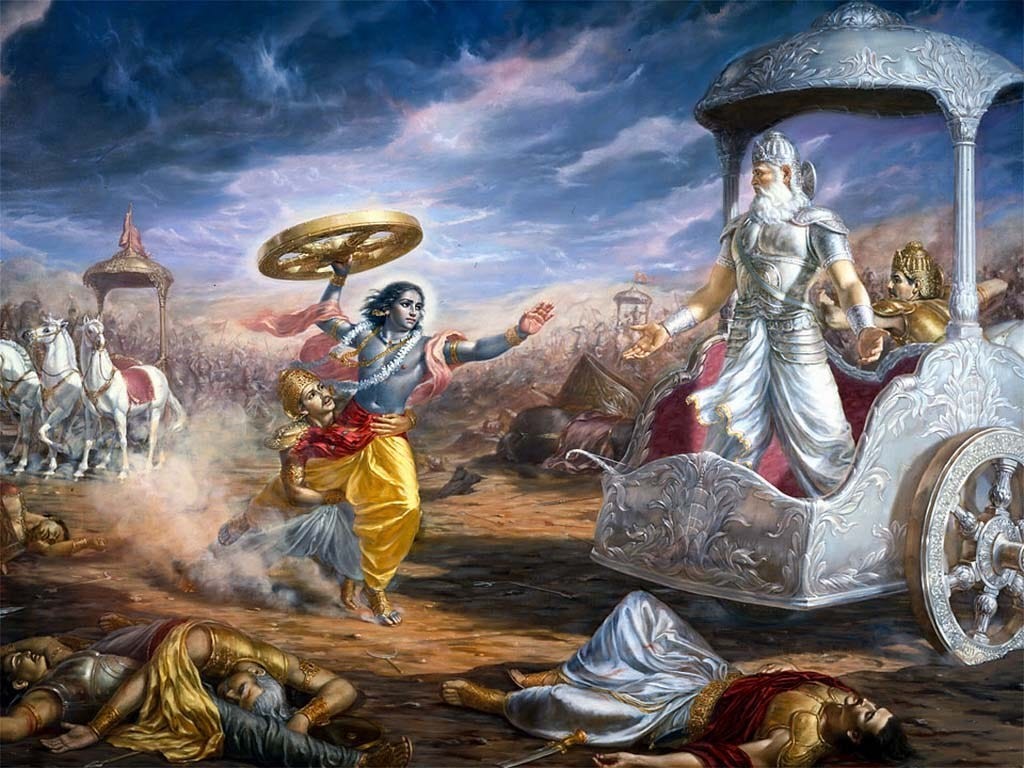
It is in our nature to love the hero. There is a natural pull of the heart. Practically every film we watch contains some form of heroic figure. In the Vedic tradition, Krishna is glorified as the supreme hero, the one who embodies every heroic archetype simultaneously and harmonizes them perfectly.
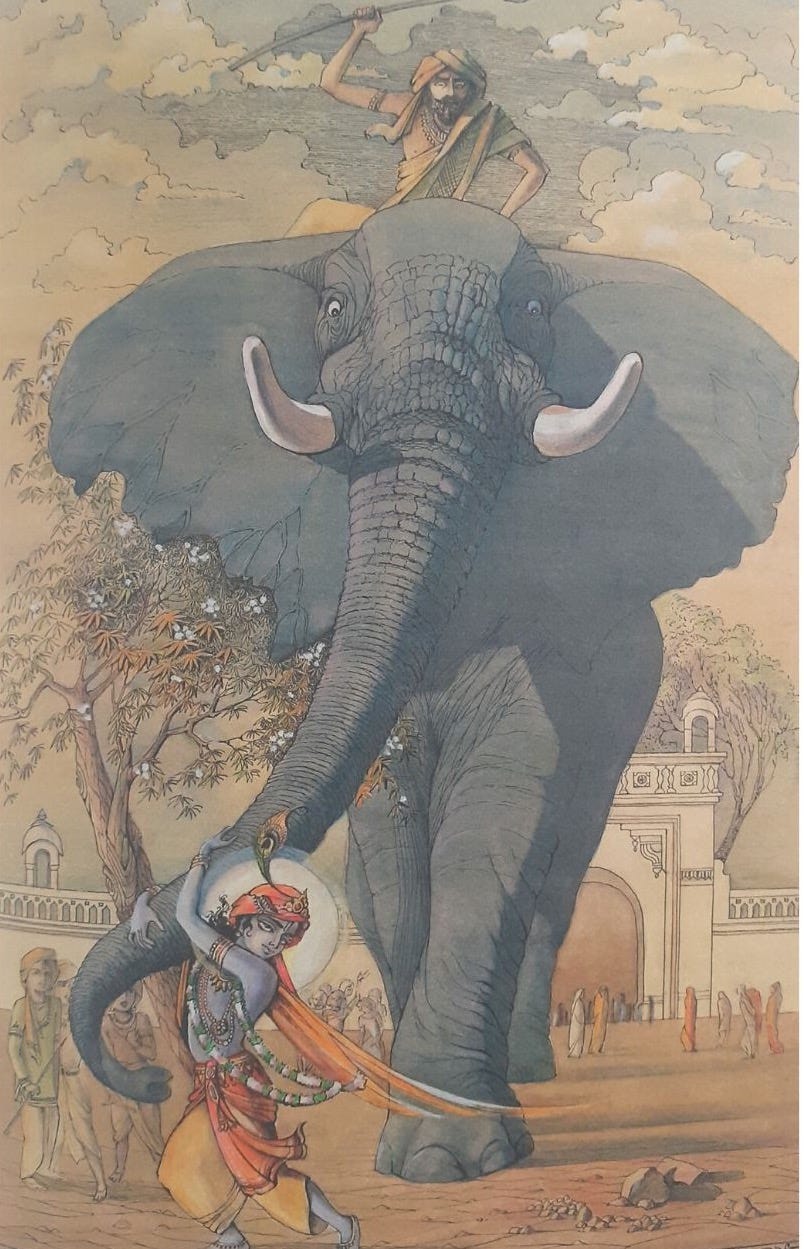
He is perfectly dhīrodātta – the noble and heroic personality. An example of this archetype is Ramachandra.
He is perfectly dhīra-lalita – the playful, charming hero, whose archetype in the material world can be seen in Kāmadeva AKA Cupid.
He is perfectly dhīra-praśānta – the peaceful gentleman, exemplified by Yudhisthira.
He is perfectly dhīroddhata - (the bad boy) - the bold and fierce assertive hero, seen in the character of Bhīma.1
And Kṛṣṇa Himself displays all of these qualities. Just think about how Krishna entered Mathura like a boss gangsta!
But in this world, we must settle for imperfect reflections. So we have our Kamalas, our Trumps, our tribes, and even sometimes our gurus. There arises a feeling that life gains purpose by honoring these heroes—or at least by opposing their villains.
When someone is on our team, when they appear to honor our group, they are easily loved and accepted. But when someone seems to stand outside that allegiance, it becomes very easy to cast them into the role of the wretched enemy.
This type of tribalism is often primitive, yet deeply subconscious. Our judgments are not always based on character or principles, but rather on group belonging.

Experiments that Illustrate This Tendency:
Consider the Party Over Policy experiment.2
Participants were given the exact same policy statement. The only difference was that it was randomly attributed to either:
a Democrat
a Republican
The result was striking.
Participants tended to support the policy only when it was attributed to their own political party. When the identical policy was attributed to the opposing party, support dropped dramatically.
The source, rather than the actual content, determined the judgment.3
A similar pattern appears in the “Out-Group Quote” experiments. Controversial quotes were judged very differently depending on the name attached to them. The exact same words could be condemned as immoral or excused as reasonable depending solely on which group the speaker belonged to.4
Research in moral psychology by Jonathan Haidt5 helps explain why this happens. His studies suggest that people typically:
1. Form a moral judgment almost immediately.
2. Then construct rational explanations afterward.
Haidt famously summarized this with the phrase:
“The mind is a lawyer, not a judge.”
In other words, we often decide first and reason later.
Of course, it is easy to read about these experiments and imagine that they describe other people. Yet if we are honest, we may recognize the same tendencies within ourselves. The impulse to defend our heroes and condemn our opponents is not limited to any particular party, nation, or ideology. It is a very human habit.

The Gītā’s Diagnosis
The Bhagavad-gītā encourages us to move beyond this mindset. Kṛṣṇa explains that our perception can become distorted by rāga (attachment) and dveṣa (aversion).
When we are attached to someone, we instinctively defend them. When we dislike someone, we instinctively condemn them.
For this reason, sattva, the mode of clarity, is praised. In sattva one strives to see things more as they are, rather than through the lens of tribal emotion.

When the Hero Instinct Enters Spiritual Life
The desire for a hero can even enter the sacred relationship of guru and student.
On one hand, we must guard our spiritual life by not succumbing to the dark tendency of the habit of critiquing others. This habit of sniffing around with the desire to find stench not only brings one’s consciousness down but also offends God himself if applied to persons of honest character.
Even those who are sincerely striving for personal growth but who occasionally stumble should not become the object of the sport of gossip.
At the same time, humility does not require blindness.
If strong evidence of inappropriate behavior appears in spiritual leadership, we should not ignore it or gaslight ourselves simply because we are afraid of losing our hero.
Discernment is required.
We should not be quick to judge, but neither should we become unwilling to see. As a general rule, bold accusations should require bold evidence.
Kṛṣṇa is our ultimate hero, and those who help connect us with Him are worthy of deep gratitude and honor.
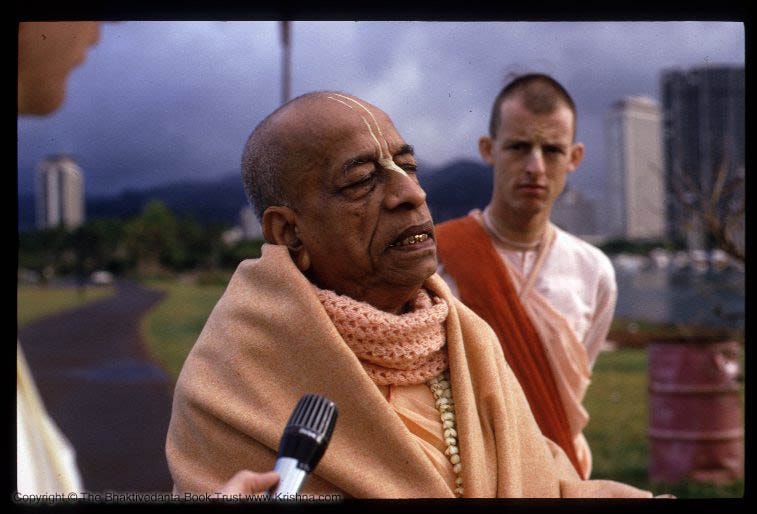
Śrīla Prabhupāda on this idol worship:
This tendency to direct reverence toward imperfect worldly leaders was something Śrīla Prabhupāda often commented on.
“You have to worship somebody. Now it is my selection whether I shall worship Lenin or Kṛṣṇa. That is a different thing. But the principle of worshiping is there in you and in me…
Now so many political parties—they have selected one god. Somebody has selected Churchill. Somebody has selected Gandhi… But they must select.”6
He then posed an important question:
“If you are selecting somebody to worship, why not the perfect? Why select the imperfect?”
He also wrote:
“The tendency to glorify others or hear others must be turned to the real object of glorification—the Supreme Being.”7
Appreciating Good Without Tribal Blindness
We should appreciate good wherever it appears. If someone does something good—even someone from a political group we dislike—we should be willing to acknowledge it.
Similarly, if someone from our own side behaves poorly, honesty should allow us to recognize that as well.
To see good when there is good, yet not gaslight ourselves with the cataracts of tribalism when wrongdoing appears—this is a form of intellectual honesty.
Even when wrongdoing must be addressed, however, that response should be thoughtful and measured. Discovering evil does not give us a license to become harsh, cruel, or self-righteous ourselves.
Lest, in fighting evil, we ourselves succumb to it.
What Can We Do to Reduce Bias?
Practice Pūrva-Pakṣa
One meaning of the Sanskrit word pakṣa is “wing,” and a bird requires two wings to fly.
In any disagreement there is:
• sva-pakṣa — one’s own position
• para-pakṣa — the opposing position
To reach sound conclusions, both sides must be carefully examined.
Ideally, we should be able to present the strongest version of the opposing argument before criticizing it. We may not agree with their conclusions, but we can still try to understand the concerns that motivate them.
In the Bhagavad-gītā, Kṛṣṇa says:
vādaḥ pravadatām aham
“Among discussions, I am that dialogue where both parties sincerely seek truth.”
This is very different from:
• jalpa — arguing simply to win
• vitaṇḍā — arguing simply so the other side loses
Understanding the Guṇas
It can also be helpful to examine the influences shaping our thinking.
In Chapter 18 of the Bhagavad-gītā, Kṛṣṇa explains that knowledge, action, determination, and even the worker themselves can be influenced by the three guṇas:
• dullness (tamas)
• agitation (rajas)
• clarity (sattva)
By reflecting on the influences we regularly absorb—our media, conversations, and habits—we may better understand the moods shaping our reactions.
Growing our Higher Attachments
Ultimately, freedom from these tendencies does not arise merely from intellectual discipline. It comes through spiritual growth.
Just as the opportunity of fresh and nourishing food naturally replaces the desire for stale food, the taste of bhakti gradually diminishes attraction to lower forms of tribal identity.
Through spiritual practice, reflection, and humility, the heart gradually loses its fascination with temporary heroes and villains and becomes attracted instead to the eternal hero—Kṛṣṇa.
Prabhupāda, A. C. Bhaktivedanta Swami. The Nectar of Devotion, Chapter 23: “Kṛṣṇa’s Personality.” Published online by Bhaktivedanta VedaBase. Available at https://vedabase.io/en/library/nod/23/
Cohen, Geoffrey L. (2003).
Party Over Policy: The Dominating Impact of Group Influence on Political Beliefs.
Journal of Personality and Social Psychology.
Fuller, S., de la Cerda, N. & Rametta, J.T. Affect, Not Ideology: The Heterogeneous Effects of Partisan Cues on Policy Support. Polit Behav 48, 273–297 (2026). https://doi.org/10.1007/s11109-025-10030-w
Lombrozo, T., et al. (2008). Moral cognition and social group membership. Trends in Cognitive Sciences, 12(11), 461–466.Lombrozo, T., et al. (2008). Moral cognition and social group membership. Trends in Cognitive Sciences, 12(11), 461–466.
Haidt, J. (2012).
The Righteous Mind: Why Good People Are Divided by Politics and Religion. https://en.wikipedia.org/wiki/The_Righteous_Mind
Prabhupāda, A.C. Bhaktivedanta Swami.
Morning Walk Conversation. Los Angeles, April 29, 1973. https://vedabase.io/en/library/transcripts/730429mwla/
Prabhupāda, A.C. Bhaktivedanta Swami.
Room Conversation. London, July 27, 1976. https://vedabase.io/en/library/transcripts/760727r1lon/
Haré Krishna! I appreciated the notes on reducing bias, and ending with Krishna 🙂
Love your clear breakdown, especially the practice of purva-paksa! I would actually quote that term when I taught Freshman Composition, and emphasize the power of the "steel man" argument. A logical fallacy is the "straw man" where we propose the weakest part of the opposing arguments and then tear it down. But a much more powerful way to engage in an argument is to present the strongest parts of the opposing arguments (the "steel") and THEN tear it down. Of course, you emphasize that true discussion is not about tearing each other down, but seeking truth. That God Himself is present is such kind of discussion. A lot less sensational but so much more profound and meaningful.